Technically, you can thaw a turkey in a cooler, but you’re basically signing up for constant ice maintenance. You’ll need to replenish ice every 30 minutes, check temperatures hourly, and keep a 2-inch ice layer to stay below 40°F. One slip-up and bacteria growth kicks in fast. A refrigerator handles this automatically, while cold water thawing gives you faster, safer results with less babysitting. Want to know which method actually works best for your timeline?
Why Coolers Aren’t Recommended for Thawing
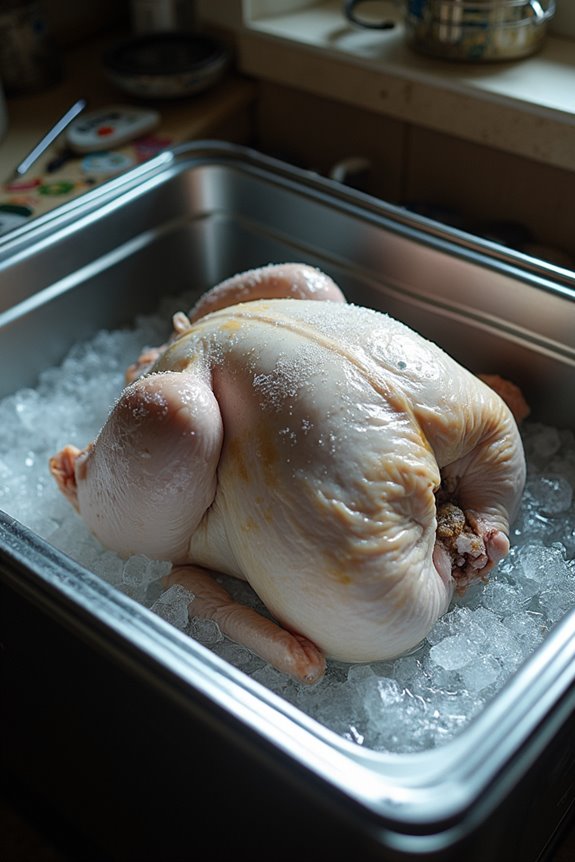
Why would you want to thaw a turkey in a cooler when you’ve got a perfectly good fridge? Here’s the thing—cooler thawing sounds convenient, but it’s honestly more trouble than it’s worth. You’ll need constant supervision to maintain that icy environment. Temperature control becomes tricky because you’re manually adding ice every few hours. One mistake, and your turkey sits in unsafe temperatures above 40°F. Food safety risks spike when you’re juggling ice levels and monitoring water. Plus, you’re dealing with potential leaks that contaminate your cooler’s interior. Your fridge does the heavy lifting automatically without requiring your attention. Sure, cooler thawing might save fridge space temporarily, but the stress and risks aren’t worth the minimal gain.
How Coolers Fail at Maintaining Safe Temperatures
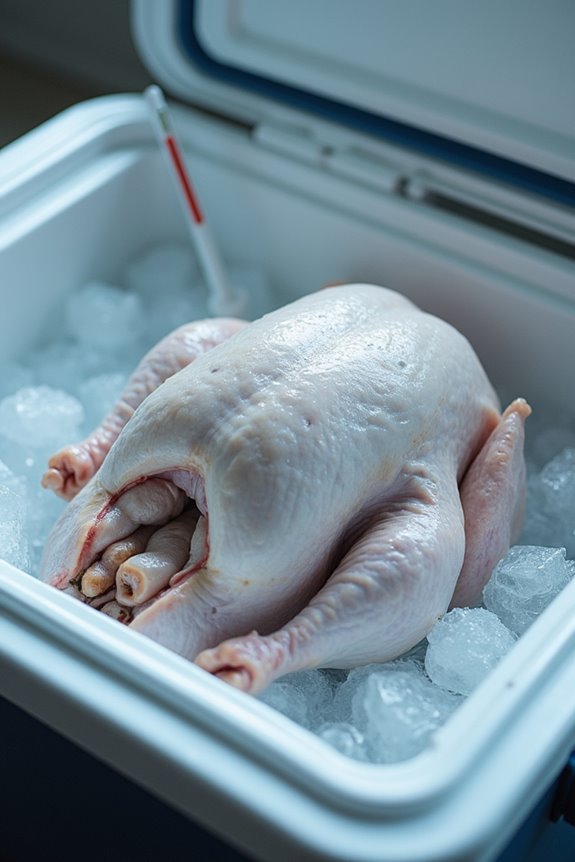
You’ll quickly realize that coolers struggle to keep turkey thawed at safe temperatures below 40°F, and there are a few key reasons why. Without constant ice replenishment, your cooler’s insulation actually works against you—it traps ambient heat inside while ice depletes faster than you’d expect. Every time you open that lid to check progress or add fresh ice, you’re letting warm air in and cold air out, which can push temperatures into the danger zone within hours.
Temperature Rise Without Ice
So the thing is: coolers don’t actually make things cold. They just slow down the warming process by holding ice. Without that ice layer, your cooler becomes basically useless for thawing safely.
Here’s what happens: ambient heat seeps in constantly through the walls and lid. Your turkey’s temperature starts climbing toward dangerous territory. Even with the lid sealed tight, you’re fighting a losing battle without ice replenishment.
You need at least a 2-inch ice layer to keep water temperatures below 40°F. Drop below that thickness? Your temperature rise accelerates quickly. That’s when bacterial growth kicks in, and you’ve got a real problem.
Monitor your cooler’s internal temperature using wireless thermometers with alarms. They’ll alert you the moment things warm up dangerously. This simple step catches cooler failure before your turkey becomes unsafe.
Insulation Traps Ambient Heat
It works both ways, and not always in your favor. Your cooler’s insulation traps cold air inside, but it also traps ambient heat from outside. When you leave that cooler in your garage or on the patio, warmth creeps in through poorly sealed lids and thin walls. Hot air circulates around your turkey, raising the internal temperature despite your ice efforts.
| Environment | Temperature Rise | Safety Risk |
|---|---|---|
| Sealed cooler, cool garage | Slow | Lower |
| Loose lid, warm garage | Fast | Higher |
| Outdoor sun exposure | Very fast | Critical |
| Uninsulated cooler | Rapid | Severe |
| Tight seal, shaded spot | Slowest | Lowest |
You’re fighting physics here. Even quality insulation can’t completely block ambient heat during extended thawing periods. That’s why location matters just as much as your cooler’s quality.
Ice Depletion Over Time
ice doesn’t last forever in a cooler. You’ll watch that 2-inch ice layer gradually shrink as hours pass. The bigger your turkey, the longer you’re stuck waiting. That means more time for ice depletion to wreck your food safety plans.
During submersion thawing, you’re adding ice regularly, but it’s never enough. You’ve got to check that cooler temperature 2–3 times daily. If you skip monitoring, the water creeps toward 41°F—and that’s when bacteria start partying.
Here’s what makes us all nervous: cooler performance actually gets worse as ice melts. Those 15–20 pound turkeys demand serious cooling power for days. Without consistent ice replenishment, your cooler becomes a warming box. Stay vigilant, keep adding ice, and check temperatures religiously.
The Temperature Danger Zone: Why Thawing Speed Matters
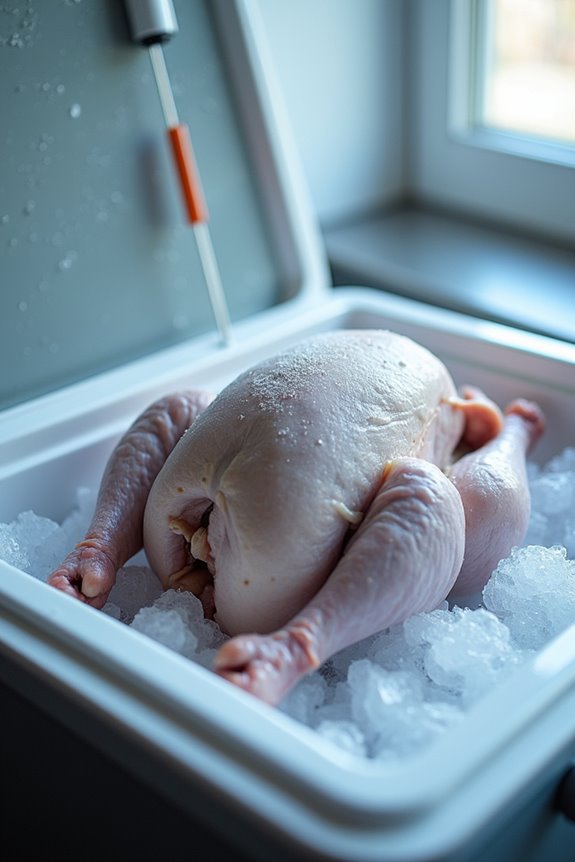
Why does thawing speed matter so much when you’re working with a frozen turkey?
Thawing speed matters because bacteria multiply rapidly once turkey reaches 40°F—patience keeps your family safe.
Here’s the thing: you’re racing against bacteria. The Temperature Danger Zone kicks in at 40°F (4°C) and higher. Once your turkey hits that temperature, harmful bacteria multiply like crazy. That’s why thawing speed actually matters—but here’s the twist. You don’t want it too fast.
Rapid thawing methods that exceed safe temperatures create dangerous conditions. Your cooler method keeps things slower and steadier by maintaining sub-40°F conditions. You’re essentially buying safety with patience. A 15–20 lb turkey needs about 24 hours in your cooler setup.
Check your thermometer 2–3 times daily. Keep that ice layer at 2 inches thick. You’re protecting your family while staying smart about food safety. That’s the real win here.
Choose Your Thawing Method: Timeline and Space Comparison
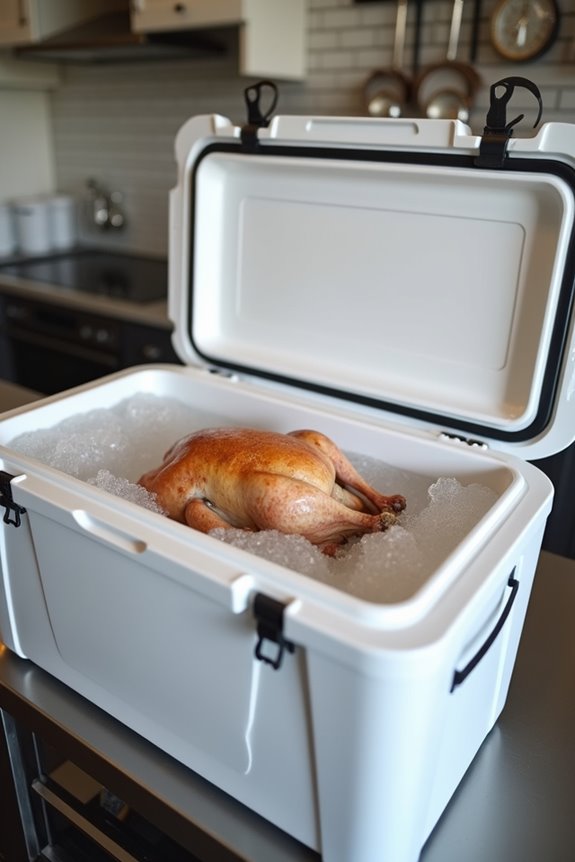
You’ve got two solid options here: your refrigerator or a cooler, and each one’s got different timing and space needs. A regular cooler thaws your turkey at about 30 minutes per pound, which means a 15–20 lb bird takes several days, but you’ll free up precious fridge space. Your refrigerator’s slower method takes about 24 hours per 4–5 pounds, so plan ahead if you’re working with limited time or cooler capacity.
Refrigerator Versus Cooler
When you’re facing a stuffed fridge and a frozen turkey, a cooler actually becomes your hidden asset. You’re joining smart cooks who’ve discovered this game-changing approach to thawing.
Here’s why many of us are switching:
- Keeps safe temperatures – Your cooler maintains below 40°F without taking up precious refrigerator space.
- Faster results – A 15–20 lb turkey thaws in 3–4 days, potentially quicker than your fridge.
- Less monitoring hassle – You’ll just check 2–3 times daily and add ice as needed.
- Perfect for gatherings – More fridge room means easier prep for sides and other dishes.
The cooler method requires maintaining a 2-inch ice layer and watching your water temperature around 34–39°F. It’s practical, efficient, and honestly? Way less stressful than the refrigerator juggling game.
Planning Your Thaw Timeline
How much time you’ve actually got makes all the difference. A regular cooler thaws your turkey at roughly 30 minutes per pound. That means a 15–20 lb bird needs about 24 hours. If you’re working with a Coleman Xtreme or similar high-end cooler, you’ve got flexibility—thawing can stretch to three days while keeping your bird at a safe temperature below 40°F.
Here’s the real deal: you’ll need to monitor your cooler setup 2–3 times daily. Check that ice layer stays around 2 inches thick and add more ice as needed. Keep that water temperature steady at 40°F or below. Once thawed, you can switch directly to brining inside the same cooler. Plan backward from your cooking time so you’re not scrambling last-minute.
Refrigerator Thawing: The Gold Standard Method
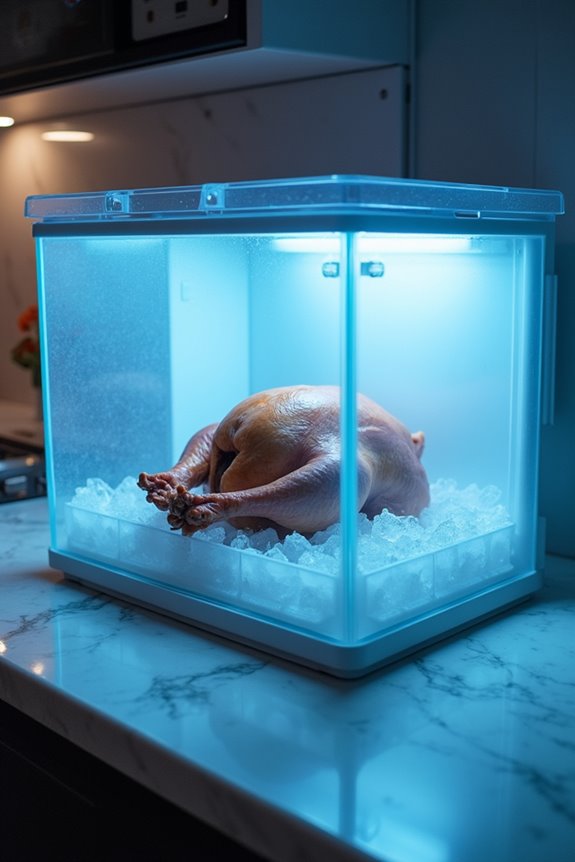
Why’s the fridge your best friend for thawing turkey? It’s the safest method around, and you’ll join thousands of home cooks who trust this approach yearly.
Here’s what makes refrigerator thawing so reliable:
- Gentle, even thawing reduces partial thawing and uneven cooking risks
- Safe thawing keeps your turkey at 40°F (4°C) or below consistently
- Cross-contamination prevention happens when you place the bird breast side up on a sheet pan on the bottom shelf
- Two-day buffer lets thawed turkey stay safe in your fridge afterward
You’ll need about 24 hours for every 4–5 pounds, so a 16-pound turkey takes roughly four days. Start thawing the Friday before Thanksgiving to ensure readiness. This straightforward method requires zero stress and delivers perfectly thawed poultry every single time.
Cold Water Thawing: A Faster and Safer Alternative
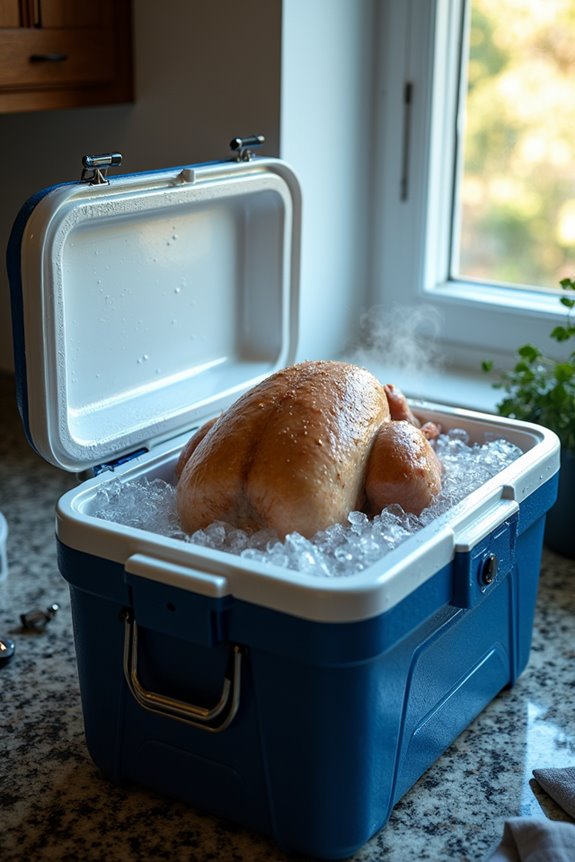
If you’re short on time, cold water thawing’s your answer. This faster method requires complete submersion in cold water, changing it every 30 minutes. You’ll need roughly 30 minutes per pound, so a 16-pound turkey needs about 8 hours.
Temperature control is crucial here—keep water at or below 40°F (4.4°C) by adding ice and monitoring with a thermometer. Using a cooler or sink works perfectly for this process.
| Turkey Weight | Thawing Time | Ice Updates | Temperature Check |
|---|---|---|---|
| 12 lbs | 6 hours | Every 30 min | Every hour |
| 16 lbs | 8 hours | Every 30 min | Every hour |
| 20 lbs | 10 hours | Every 30 min | Every hour |
| 24 lbs | 12 hours | Every 30 min | Every hour |
| 28 lbs | 14 hours | Every 30 min | Every hour |
Once thawed, cook immediately or refrigerate promptly to prevent bacterial growth.
Microwave Thawing: When You’re Short on Time
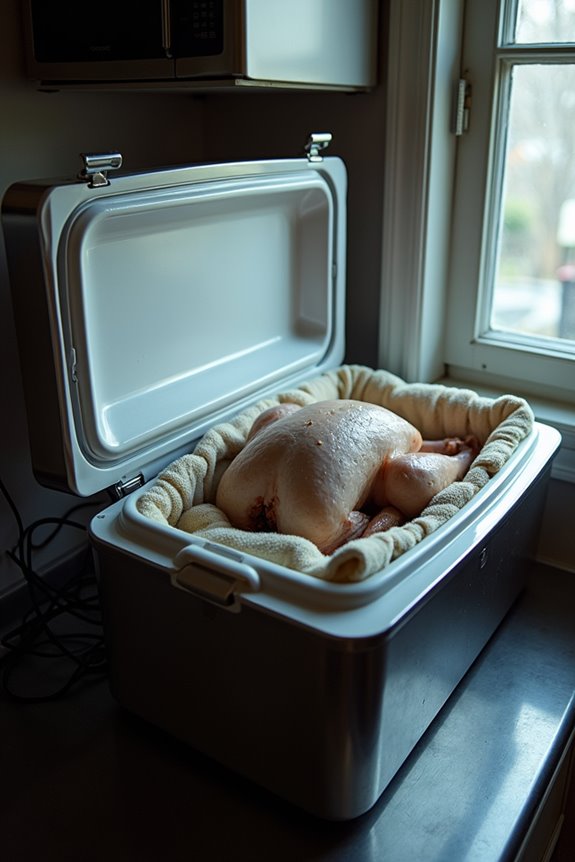
When you’re down to the wire, microwave thawing’s your quickest escape route. This time-saving method beats waiting around for cooler thawing, especially when you’ve procrastinated. You’ll use the defrost setting based on weight—roughly six minutes per pound.
Here’s your game plan:
- Remove the outside wrapping and place your turkey on a microwave-safe dish.
- Rotate and flip your bird multiple times during thawing to ensure even defrosting.
- If cooking starts accidentally, let it rest five minutes before resuming thawing.
- Check your microwave’s owner’s manual for size-specific defrost times and power levels.
Cook immediately after thawing completes. Skip counter or garage thawing entirely—microwave’s your safe bet. You’ve got this handled, and your turkey’s dinner-ready faster than you’d think.
Why Partial Thawing Causes Cooking Disasters
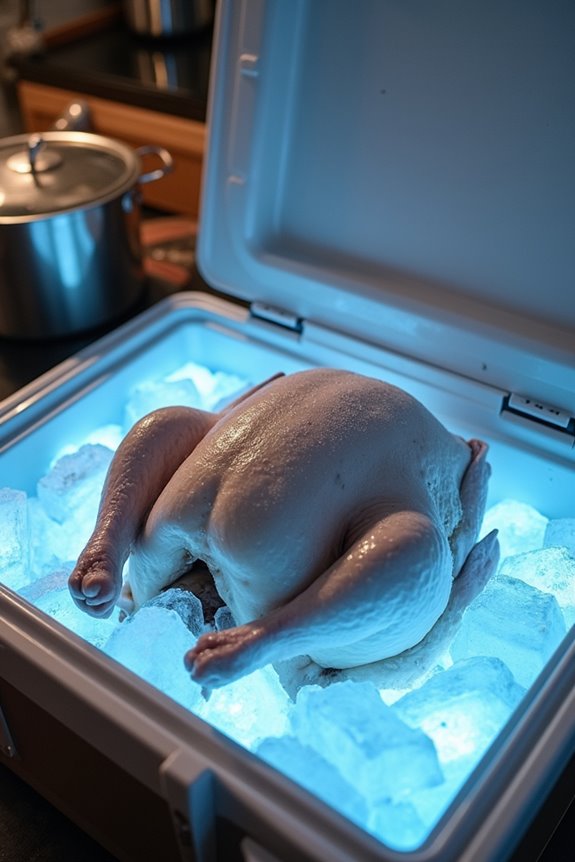
Partial thawing’s basically a recipe for disaster, and you’ve probably heard someone defend it as a time-saver. Don’t fall for it.
When you partially thaw your frozen turkey, the outside warms up while the center stays rock-solid. This creates two problems: bacteria love those thawed outer sections, and your oven will overcook the breast meat trying to finish the inside.
| Problem | What Happens | Why It Matters |
|---|---|---|
| Uneven temperatures | Outside thaws, center frozen | Unsafe and dry meat |
| Bacterial growth | Warm zones promote bacteria | Food poisoning risk |
| Dry breast meat | Outside overcooks first | Disappointing texture |
| Unsafe cooking | Center below 165°F | Health hazard |
| Wasted turkey | Ruined dinner | Frustration and expense |
Safe thawing means going all-in: complete fridge thawing, cold-water submersion, or microwave thawing. Skip the partial thaw shortcut entirely.
How to Confirm Your Turkey Is Fully Thawed
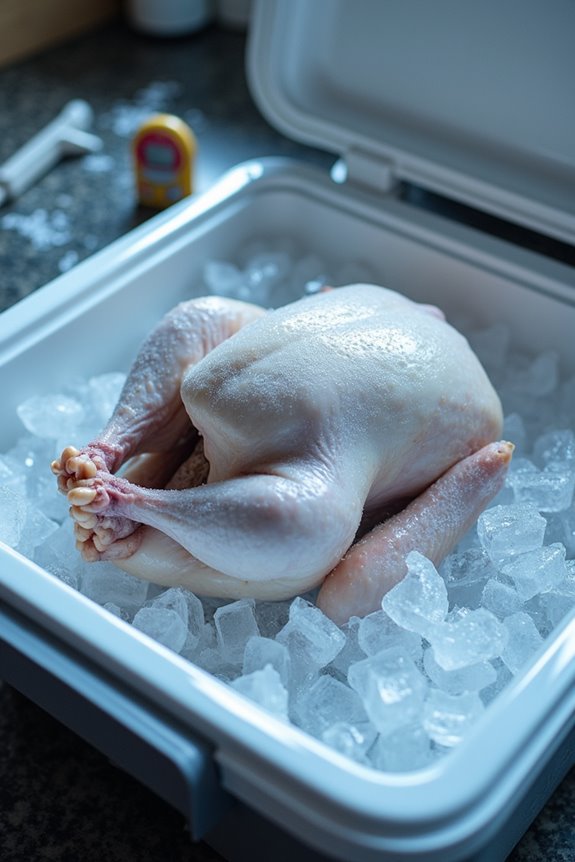
Now that you’re avoiding the partial-thaw trap, you’ll want to know exactly when your turkey’s actually ready.
After 3–4 days of cooler thawing, it’s time for thaw confirmation. You’ll need to verify your turkey’s completely thawed before cooking.
- Insert a thermometer into multiple breast locations and check readings above 32°F
- Feel the flesh—it should be pliable and soft, not hard or icy
- Use temperature monitoring to ensure water stays at or below 40°F throughout
- Skip the guessing game by checking the thickest parts near the bones
The spongy texture you’re feeling means you’re on track. Your cooler thawing method works best when you’re patient and consistent. Once flesh yields to gentle pressure everywhere, you’ve nailed it. You’re ready to cook with confidence, knowing you’ve done the thaw confirmation right and kept food safety standards intact.